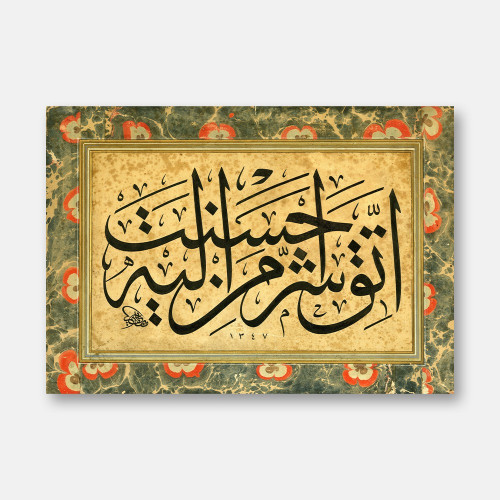



Mustafa Halim Özyazıcı
He was born in Istanbul on 20 Sha'ban 1315 AH / 14 January 1898 CE as the son of Nalıncı Hacı Cemâl Efendi. His original name is Mustafa Abdülhalim. He studied at Esekapısı Primary School and later at Gülşen-i Ma’arif Secondary School in Haseki. He received lessons in Thuluth and Naskh from Hâmid Aytaç, who was the school's calligraphy teacher, and lessons in Diwani and Riqa from Ferîd Bey. After graduating, he entered the engraving and painting department of the Sanayi-i Nefîse Mektebi (Academy of Fine Arts). The following year, he enrolled in the newly opened Medresetü’l-hattatîn (School of Calligraphers). Here, he again studied Thuluth and Naskh under Hasan Rızâ Efendi and Kâmil Akdik, Jali Thuluth under Tuğrakeş İsmâ’il Hakkî Altunbezer, and Ta'liq under Hulûsî Yazgan. After earning his diploma (şahâdetnâme) from Medresetü’l-hattatîn on 20 Dhu al-Hijjah 1336 AH / 27 September 1918 CE, he entered the Bureau of the Imperial Council (Dîvân-ı Hümâyûn Kalemi).
Upon being conscripted into the military, he was appointed as the calligrapher for the Military Printing House. Later, the post of calligrapher for the Evkaf (Endowments) Printing House was also entrusted to him. Released from service following the proclamation of the Republic, he opened a calligraphy studio around Bâb-ı Âlî. Although he briefly served as the calligrapher for the State Printing House, he was forced to leave this position due to the Alphabet Reform. When his request to settle in Egypt was rejected, he closed his studio and retired to his home in Tepebağı.
He was born in Istanbul on 20 Sha'ban 1315 AH / 14 January 1898 CE as the son of Nalıncı Hacı Cemâl Efendi. His original name is Mustafa Abdülhalim. He studied at Esekapısı Primary School and later at Gülşen-i Ma’arif Secondary School in Haseki. He received lessons in Thuluth and Naskh from Hâmid Aytaç, who was the school's calligraphy teacher, and lessons in Diwani and Riqa from Ferîd Bey. After graduating, he entered the engraving and painting department of the Sanayi-i Nefîse Mektebi (Academy of Fine Arts). The following year, he enrolled in the newly opened Medresetü’l-hattatîn (School of Calligraphers). Here, he again studied Thuluth and Naskh under Hasan Rızâ Efendi and Kâmil Akdik, Jali Thuluth under Tuğrakeş İsmâ’il Hakkî Altunbezer, and Ta'liq under Hulûsî Yazgan. After earning his diploma (şahâdetnâme) from Medresetü’l-hattatîn on 20 Dhu al-Hijjah 1336 AH / 27 September 1918 CE, he entered the Bureau of the Imperial Council (Dîvân-ı Hümâyûn Kalemi).
Upon being conscripted into the military, he was appointed as the calligrapher for the Military Printing House. Later, the post of calligrapher for the Evkaf (Endowments) Printing House was also entrusted to him. Released from service following the proclamation of the Republic, he opened a calligraphy studio around Bâb-ı Âlî. Although he briefly served as the calligrapher for the State Printing House, he was forced to leave this position due to the Alphabet Reform. When his request to settle in Egypt was rejected, he closed his studio and retired to his home in Tepebağı.